salakhalimunmountain.com – Trekking after dark through the dense rainforests of Mount Salak and Halimun National Park offers an otherworldly wilderness experience, but it also strips away your primary spatial anchor: daylight. Under a multi-layered canopy where moonlight cannot penetrate, night trekking introduces a subtle psychological and perceptual challenge—sensory deprivation. When your visual field narrows to the beam of a headlamp, your spatial awareness contracts, trail depth perception flattens, and ambient jungle noises intensify. Dealing with sensory deprivation in night treks is an essential night-hiking discipline that helps you navigate safely, maintain psychological composure, and thrive under Java’s nocturnal canopy.
In total darkness, the brain struggles to construct a clear picture of the surrounding environment. Without distant landmarks, a horizon line, or peripheral visual cues, your nervous system can misinterpret shadows, overestimate slope steepness, or experience spatial disorientation. By optimizing illumination setups, slowing your physical pace, engaging alternative sensory cues, and keeping your mind grounded, you can master night navigation across the wildest terrain of Salak and Halimun.
Optimizing Lighting Systems for Depth Perception
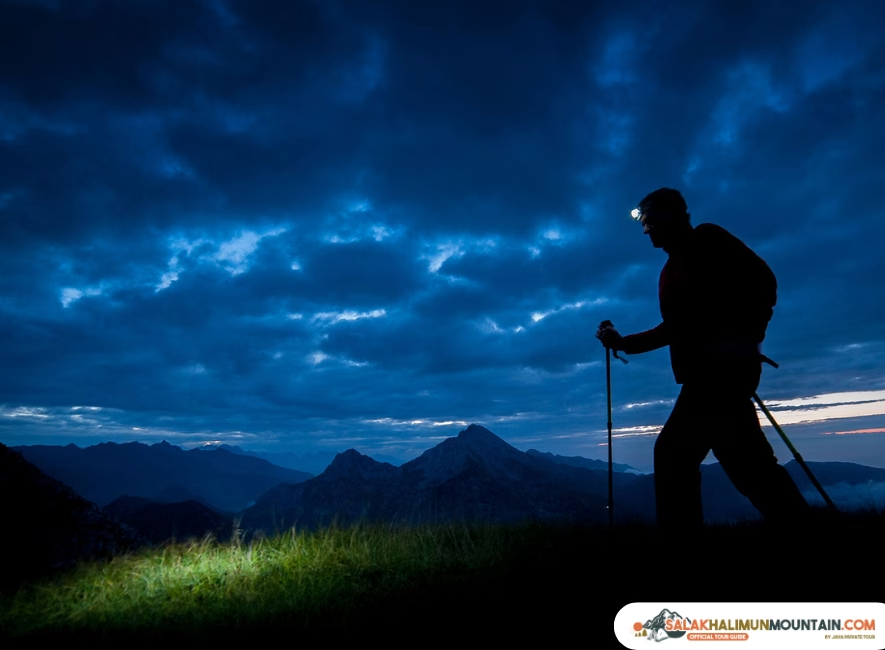
The primary driver of sensory limitation during night hikes is poor lighting. Relying on a single narrow-beam light source casts harsh shadows and flattens terrain depth, making wet roots, mud pockets, and rock drops appear featureless and flush with the ground.
To restore three-dimensional depth perception, combine a high-lumen, broad-flood headlamp with a secondary waist-level or hand-held light source. Mounting a light at waist level casts longer, natural shadows across surface textures, immediately highlighting root contours and subtle steps. Choose headlamps with warm-tint LED chips rather than harsh cold-white light, as warmer color temperatures improve contrast and reduce glare against fog and water droplets.
Preserving Night Vision and Peripheral Awareness
Constantly switching between high-intensity light and complete darkness strains your eyes and destroys your natural scotopic (night-adapted) vision, which takes up to 30 minutes to fully develop.
Use lower brightness settings on flat, clear trail sections to allow your peripheral vision to adjust to ambient forest light. When stopping for rest breaks, switch your headlamp to red-light mode. Red wavelength light preserves night-vision adaptation while allowing you to read maps, adjust gear, and communicate with teammates without blinding anyone in your group.
Adapting Footwork, Pacing, and Spatial Movement
Attempting to maintain your daytime hiking speed during a night trek increases trip risks and accelerates mental fatigue. When visual information is limited, your physical mechanics must adapt to compensate for reduced foresight.
Shorten your stride significantly and keep your weight centered directly over your feet. Practice “feeling” the ground through your boots before transferring your full body weight onto a step—a technique often called probing footwork. Use trekking poles actively as forward antennae, tapping terrain features 1 to 2 steps ahead to gauge rock stability, mud depth, and slope drop-offs before your boots make contact.
Managing the “Tunnel Vision” Fatigue Effect
Staring continuously into a tight 2-meter cone of light for hours causes severe eye strain and mental fatigue, leading to a sensation of hypnotic detachment known as trail hypnosis.
To break tunnel vision, consciously tilt your head up every few minutes to sweep your light beam forward along the trail path and into the mid-canopy above. Scanning your broader surroundings reassures your brain of the surrounding space, maintaining situational awareness and keeping your mind sharp.
Grounding the Mind Against Auditory Amplification
When visual inputs decrease, the brain naturally heightens auditory sensitivity to compensate. In the nocturnal rainforest of Mount Salak and Halimun, nocturnal insects, tree frogs, rustling canopy winds, and snapping twigs sound unnaturally loud and close.
Unfamiliar noises in the dark can trigger hyper-vigilance or mild anxiety. Ground yourself by rationalizing environmental sounds: the vast majority of nocturnal noise comes from small arboreal mammals, frogs, or falling forest debris. Focus on the steady rhythm of your breathing, the sound of your own footsteps, and the presence of your team to maintain emotional calm.
Leveraging Team Cohesion and Communication
Night trekking should always be a collective effort. Moving in a tight, organized file provides psychological comfort and ensures no team member becomes isolated in the dark.
Maintain close spacing between hikers—roughly 1.5 to 2 meters apart—so everyone remains within the illumination footprint of the group. Establish a clear verbal call-out protocol: the lead hiker calls out low branches, slick root networks, and sudden turns, passing warnings back down the line. Keeping up constant, calm communication turns the dark forest into a shared, supportive adventure environment.
Dealing with sensory deprivation in night treks transforms how you perceive the rainforest. By refining your lighting, adapting your footwork, rationalizing nighttime sounds, and moving in harmony with your group, you turn the dark trails of Mount Salak and Halimun into a peaceful, awe-inspiring nocturnal journey.
So, if you’re ready to explore the wonders of Mount Salak Halimun, head over to our ONLINE BOOKING PAGE and let’s start planning your adventure. Or simply CLICK THIS LINK to chat with us on WhatsApp.
With our team, you’re not just getting a guide; you’re gaining a local friend who will ensure your trip is nothing short of extraordinary.